

 Business License

Application of ZPS in the Electroplating Industry
1. Overview
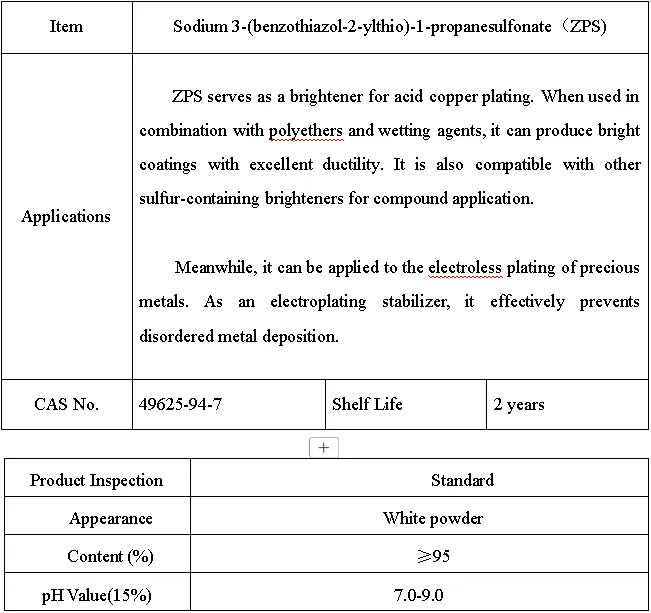
Sodium 3-(benzothiazol-2-ylthio)-1-propanesulfonate (commonly called ZPS, CAS No.: 49625-94-7) is a vital organic electroplating additive. Its molecular structure contains benzothiazole ring, sulfhydryl group (-SH) and sodium propane sulfonate group. This unique structure endows it with excellent water solubility, ionic properties and chemical reactivity. It is widely applied in the electroplating industry, and plays a critical role especially in copper plating and precious metal electroplating processes, with core functions of optimizing coating quality and improving electroplating process stability.
2. Mechanism
The action mechanism of ZPS in electroplating is mainly based on the characteristics of active groups in its molecular structure, which is divided into three aspects:
As an active functional group, the sulfhydryl group (-SH) can adsorb on the cathode surface, enhance cathode polarization and increase the saturation of adsorbed atoms. Meanwhile, it introduces lattice defects, boosts nucleation quantity and hinders the diffusion of adsorbed atoms to growth centers, thereby achieving grain refinement. This process generates high overpotential by increasing polarization to ensure high saturation of adsorbed atoms, and raises the disorder of adsorbed atoms entering the lattice to further strengthen the grain refining effect.
The benzothiazole ring features outstanding stability and adsorptivity, which assists sulfhydryl groups in strengthening adsorption capacity and reducing coating defects.
The hydrophilicity of sodium propane sulfonate group enables uniform dispersion of the compound in aqueous electroplating systems to ensure consistent performance. It also improves compatibility with other water-soluble additives, laying a foundation for synergistic effects with polyethers, wetting agents and other additives.
3. Applications
3.1 Acid Copper Plating Process
Acid copper plating is the primary application field of ZPS. It delivers prominent performance in both conventional acid copper plating and phenol dye-based acid copper plating systems. As a key brightener component used in combination with polyethers and wetting agents, it forms high-brightness and high-ductility copper coatings and greatly improves surface quality of finished products, with specific advantages as follows:
Grain Refinement: Serving as a grain refiner, it significantly reduces coating grain size for a smoother and denser coating surface. It eliminates surface defects such as roughness and streaks, enhances surface finish, and improves coating ductility to prevent brittle cracking. This effect is particularly notable in phenol dye-based acid copper plating, effectively solving the common problem of coarse grains in such systems.
Coating Performance Improvement: By optimizing the grain structure, it strengthens the adhesion between the coating and substrate to reduce peeling and flaking. It also enhances coating corrosion resistance, weakens environmental erosion and extends service life. It is widely used for copper plating of metal parts in automotive, construction and other industries to guarantee long-term structural integrity of components.
3.2 Precious Metal Electroplating Process
ZPS acts mainly as a stabilizer in the electroplating of precious metals such as gold and silver. It effectively prevents irregular deposition of precious metal ions on the cathode surface to ensure uniform and dense coatings, improves substrate adhesion, and minimizes defects like pinholes and pitting. Through the synergistic adsorption of benzothiazole rings and sulfhydryl groups, it stabilizes the electrochemical environment on the cathode surface and inhibits abnormal growth of precious metal grains, delivering uniform and bright coatings with upgraded wear and corrosion resistance. It is suitable for electroplating processing of high-precision products including precious metal ornaments and electronic components.
3.3 Precision Electronic Electroplating Process
ZPS plays an essential role in the manufacturing of precision electronic components such as PCB electroplating and copper plating for electronic connectors. Its grain refining and densification properties effectively enhance the electrical conductivity and corrosion resistance of electronic components, maintaining stable electrical performance during long-term service. Given the extremely high coating quality requirements of precision electronic electroplating, the addition of ZPS effectively avoids pinholes, cracks and other defects, ensuring packaging reliability and service life of electronic components. In addition, its superior water solubility and compatibility enable synergistic interaction with other additives in electronic electroplating systems to further optimize process stability.
4. Product Introduction
Wuhan Hugarise New Material Co., Ltd. supplies industrial-grade ZPS. It is widely adopted as a brightener for acid copper plating. When combined with polyethers and wetting agents, it produces bright and highly ductile coatings, and can be compounded with other sulfur-containing brighteners. In addition, it is applicable to electroless plating of precious metals as an electroplating stabilizer to avoid disordered metal deposition.
Recently Posted
-
Chemicals for copper foil electroplating: tensile properties and applications
August 26, 20261. Industry Pain Points and Core Application Value of H1 AdditivesIn electrolytic copper‑foil production and copper‑plating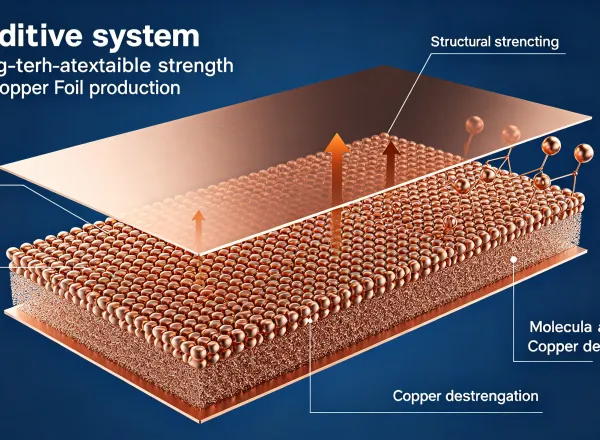 Read More
 -
Copper Foil Electroplating Chemicals — Functions of Brighteners and Industrial Applications
August 13, 202601. Core Value: Acid Copper Plating & Electroplating IntermediatesAcid copper plating is a vital process for hardware electrop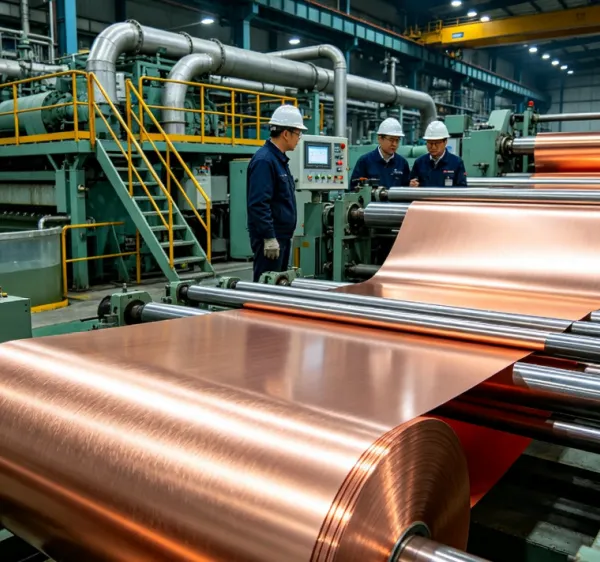 Read More
 -
Copper Foil Electroplating Chemicals – Functions & Industrial Applications of Grain Refiners
July 29, 20261. Core Functions of Electroplating Intermediates in Acid Copper Plating & High-Grade Copper Foil Process Electroplating Read More
 -
Application of Perfluorohexylethyl Anionic Surfactant
July 29, 20261. Overview Perfluorohexylethyl sulfonates are a key class of per- and polyfluoroalkyl substances (PFAS Read More

Contact Us
Recommended Products
-
 GuanineNegotiableMOQ: 25 Kilograms
 -
β-hydroxy-4-(2-hydroxyethyl)piperazine-1-propanesulphonic Acid (HEPPSO)NegotiableMOQ: 25 Kilograms
-
3-(Cyclohexylamino)2-hydroxy-1-propanesulfonic Acid (CAPSO)NegotiableMOQ: 25 Kilograms
-
3-Cyclohexylaminopropane-1-sulphonic Acid(CAPS)NegotiableMOQ: 25 Kilograms
-
4-(N-morpholino)butyric Acid (MOBS)NegotiableMOQ: 25 Kilograms
-
4-(cyclohexylamino)butane-1-sulfonic Acid (CABS)NegotiableMOQ: 25 Kilograms
-
N-(2-Hydroxyethyl)piperazine-N'-(4-butanesulfonic Acid) (HEPBS)NegotiableMOQ: 25 Kilograms
-
3-(3-Cholamidopropyl)-dimethylamino-1-propanesulfonic Acid (CHAPS)NegotiableMOQ: 25 Kilograms
-
2-hydroxy-3-[[2-hydroxy-1,1-bis(hydroxymethyl)ethyl]amino]propanesulphonic Acid (TAPSO)NegotiableMOQ: 25 Kilograms
-
3-(tris(hydroxymethyl)methylamino)propane-1-sulphonic Acid (TAPS)NegotiableMOQ: 25 Kilograms
-
3-Morpholinepropanesulfonic Acid (MOPS)NegotiableMOQ: 25 Kilograms
-
4-(2-Hydroxyethyl)-1-piperazinepropanesulfonic Acid (HEPPS)NegotiableMOQ: 25 Kilograms
-
Aliphatic Polyoxyethylene Ether SulfonateNegotiableMOQ: 25 Kilograms
-
3-MercaptopropyltriethoxysilaneNegotiableMOQ: 25 Kilograms
-
3-AminopropyltriethoxysilaneNegotiableMOQ: 25 Kilograms
-
Epoxy Silane OligomerNegotiableMOQ: 25 Kilograms
-
Vinyl Silane OligomerNegotiableMOQ: 25 Kilograms
-
Sodium 3-(benzothiazol-2-ylthio)-1-propanesulfonate(ZPS)NegotiableMOQ: 25 Kilograms
-
Sodium 3-sulfopropyl Methacrylate (SPM-Na)NegotiableMOQ: 25 Kilograms
-
1,3-Bis[3-(dimethylamino)propyl]urea (PU)NegotiableMOQ: 25 Kilograms
![1,3-Bis[3-(dimethylamino)propyl]urea (PU)](https://img13.fr-trading.com/3/1_629_120264_1000_1000.jpg.webp)
